A customer photographs the back of her shampoo, uploads the image to an app – and reads: 'lots of chemicals'. Another app calls the same shampoo 'pure natural cosmetics'. Sarah Lindt, hair-growth specialist and YELASAI trainer, wanted to ask founder Gianni Coria how this can be, what really goes into his care – and what responsibility for people at every stage of life means.
A conversation by Sarah Lindt, hair-growth specialist and YELASAI trainer, Haarbutik
Gianni Coria has heard such stories many times before. Since 2010, he has been developing scalp and hair care in Switzerland that isn't available in shops – but through trained hair-growth specialists and directly in his own shop. When he talks about ingredients, it's not like someone who has something to defend, but like someone who has personally selected every ingredient.
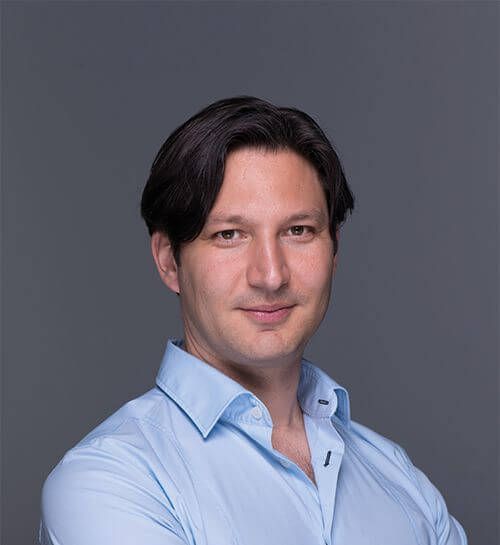
Mr Coria, an app rates your shampoo as 'lots of chemicals'. Does that annoy you?
'Annoy is the wrong word. I understand where it comes from. Most apps and many AI chats only read the names on the ingredients list. They don't know how much of a substance is in the product – and they don't know what quality we use it in. That's exactly what matters. An ingredients list shows the order, but neither the quantity nor the quality.'
'An app knows neither the quantity nor the quality of the raw materials. Those are precisely what determine how good a product is.'Gianni Coria
Why isn't the quantity on the label?
'Because it's part of the formulation. The exact dosage is the knowledge that makes a product – no manufacturer publishes that. For the apps, though, that means they calculate on the basis of the worst-case scenario, to be on the safe side. If they knew our dosage, they would rate many things quite differently.'
And the quality?
'You can't see that on any label. Two products can have the same name on the list and still contain completely different raw materials. Our comfrey, for example, is PA-purified – meaning it's been freed from certain natural plant compounds that you don't want in care products. On the ingredients list, it still just says "Symphytum Officinale". An app can't recognise this difference. It rates a word, not a raw material.'
Most often, the apps flag names like citral, limonene or linalool. What's that about?
'Those are natural components of the essential oils we use to scent our products. Lavender naturally contains linalool, lemon contains limonene. The law requires these components to be listed individually on the label once a very low threshold is reached. It's a mandatory declaration for people with a known fragrance allergy – not an additional substance.'
One point is particularly close to his heart: 'Our essential oils are refined and optimally dosed – just enough for a natural scent. The app only sees the name, not how little of it is in there.'

A second warning word is 'sulphate'. Your shampoo contains sodium coco-sulphate.
'Yes, and we say that openly. When people read "sulphate-free", they usually mean SLS and SLES – two strong cleansing substances found in many inexpensive shampoos. We don't contain those. Sodium coco-sulphate is a cleansing surfactant from coconut and is also approved in natural cosmetics standards. With us, the primary cleanser is a sugar surfactant, and the accompanying surfactants make it even milder. That's why our shampoo is gentle enough for the whole family.'
And the preservatives?
'Every product that contains water must be protected from germs after opening. Otherwise it would spoil after a short time. We use nature-identical substances, as they also occur in food and are approved in certified natural cosmetics. Our oils and herbal powders contain no water – they don't need any preservation at all.'
So what actually goes into your care?
Here Gianni Coria becomes animated. He talks about the fermented herbal extract from porcini mushroom, maidenhair moss and comfrey that's in almost all YELASAI liquid products. 'This ferment matures for 36 months. For us, that's not a raw material, that's the heart of it.' Added to that is an herbal complex of up to fifteen plants – birch, nettle, rosemary, chamomile, Damask rose and others. 'Each plant must be named individually. That's why our lists are so long. Not because there are lots of chemicals in it, but lots of plants.'
'Our lists are long – not because there are lots of chemicals in it, but lots of plants.'Gianni Coria
But for Gianni Coria, it's not just what's in the bottle that counts – but above all, who it's intended for.

Responsibility for every person in the salon chair
Who actually sits in the chair at your specialists' salons?
'The whole of life,' says Gianni Coria with a smile. 'Children who come with their mother. Teenagers who aren't comfortable in their skin just now. Women and men of every age – after a birth, during the menopause, in the middle of their working life or in retirement. People who have a difficult time behind them or are right in the middle of it. And women who are pregnant or breastfeeding and look particularly carefully at what they use.'
This diversity is the real benchmark for him. Care that only works for a particular group would be too little for YELASAI.
'In our chairs sit children, teenagers, mothers, fathers and grandparents. Our care must be right for every one of them.'Gianni Coria
What does responsibility mean to you, quite concretely?
'That we ask two questions about every raw material: Is it gentle? And does it bring real benefit to skin, scalp and hair? Only if both are true does it go into our formulation. Our goal is care that keeps the scalp's environment in balance, without burdening it.'
That's why, he explains, YELASAI avoids silicones, parabens, mineral oil and hormones – and instead uses mild surfactants, plant oils, fermented herbs and a dosage that's fine-tuned down to the last detail. 'Gentle doesn't mean ineffective for us. Gentle means: the scalp gets what's good for it, and nothing that unnecessarily challenges it.'
'Gentle doesn't mean ineffective for us. Gentle means: the scalp gets what's good for it – and nothing that unnecessarily challenges it.'Gianni Coria
And if a customer is pregnant or breastfeeding?
'Then we congratulate her warmly first of all,' he says. 'During this time, many women want care that simply feels good and doesn't burden. Our specialists put together care during this phase of life that's deliberately gentle and purely external – for example with the mild shampoo, the tonic and the spray. No one should have to worry about their hair care during this special time.'
And with children?
'Our shampoo and our conditioner are so mild that they can be used even on the very young. With children, less is often more: gentle washing, gentle care, gentle brushing. If parents are unsure, the specialist is happy to take time for their questions.'
Many people also come to you during difficult phases of life.
'Yes, and especially then, attitude counts more than any product,' says Gianni Coria quietly. 'Anyone experiencing a stressful time doesn't need big promises, but care, dignity and someone who listens. That's why we have partners who are specially trained for this kind of support. The care is then above all one thing: a piece of wellbeing and normality.'
Care you can't see
For YELASAI, responsibility begins long before a bottle reaches the salon. Raw materials are selected for quality – not for the cheapest price. The herbal ferment matures for 36 months. The concentrates are documented batch by batch, and manufacturing takes place in Switzerland.
And responsibility doesn't end with the sale, either. 'At the beginning there's always the look at the scalp,' says Gianni Coria. 'Only when the specialist understands what the scalp needs does she choose the care. And then she accompanies the customer over months, records progress in images and adjusts the care if something changes. That's care as we understand it.'
Why don't you simply sell in the chemist's?
'Because a bottle on the shelf doesn't listen to anyone. With us, everything begins with the scalp. A trained specialist looks at it, chooses the appropriate care and accompanies the customer over months. Analysis instead of guesswork. This support is the real difference – and no app can provide that.'
What do you advise a customer who comes to her specialist with an app verdict?
'To read the warning as a pointer, not as a verdict. A red flag only means: this name is on a list. Anyone with a known intolerance will find the substance immediately on the label thanks to the mandatory declaration – that's exactly what it's there for. And then simply ask. Our specialists know every product and see the scalp. That's worth more than any word list.'
'A red flag only means: this name is on a list. Ask your specialist – she sees your scalp.'Gianni Coria
Briefly explained
- An ingredients list (INCI) names the substances, but neither their quantity nor their quality. Apps and AIs therefore often rate more strictly than necessary.
- Citral, limonene, linalool & co. come from natural essential oils and are a legal mandatory declaration. Sodium coco-sulphate is a coconut surfactant, not SLS or SLES.
- Every raw material must be gentle and benefit skin, scalp and hair – without silicones, parabens, mineral oil and hormones.
- Designed for all life stages: from children to grandparents, deliberately gentle and external during pregnancy and breastfeeding.
- The complete ingredients are on every product page and on the label.
Would you like to know which care suits your scalp? A hair-growth specialist near you will advise you personally.
Find a specialistView the shampooFrequently asked questions
Ingredients & compatibility
Why do apps rate the same shampoo so differently?
Ingredient apps and AI chats usually only rate the names on the ingredients list. Neither the quantity of a substance nor the quality of the raw material actually used is stated there – both are part of the formulation. Because dosage and quality are unknown, many programmes calculate on the basis of the worst-case scenario.
Is the YELASAI shampoo suitable for children?
Yes. The Ayurveda Hair Active Shampoo is very mild and designed for the whole family.
Is YELASAI care suitable during pregnancy and breastfeeding?
During this phase of life, the YELASAI hair-growth specialists put together care that's deliberately gentle and purely external – for example with the mild shampoo, the tonic and the spray.
Hair-growth specialist & consultation
What does a YELASAI hair-growth specialist do?
She first looks at the scalp with a micro-camera at 50 to 200 times magnification. From this she puts together a personal care concept for home and also cares for the scalp in the salon, for example with an Ayurvedic scalp massage or a deep cleanse. Afterwards she accompanies her customer over months and records the changes in comparison images.
Why do I need the advice of a specialist?
Because you can rarely tell from the outside what the scalp needs. Whether it's oily, dry, irritated or covered with deposits, it needs different care in each case – under the micro-camera this becomes visible. And because the specialist accompanies you over months, you also see what changes. For initial questions there's an AI chat on yelasai.com, to which you can also send a photo of the scalp.
Does the hair-growth specialist make a diagnosis?
No. The scalp analysis is a cosmetic assessment: it shows the state of the scalp, hair roots and hair density, and is the basis for the appropriate care. Anyone who already has a medical diagnosis can begin the care in parallel – the scalp can always be cared for.
Is YELASAI the same as a hair clinic?
No. In a hair clinic, doctors treat or transplant hair. YELASAI is a Swiss brand for scalp and hair care with a network of over 290 listed hair-growth specialists in salons. Their area is the cosmetic care of the scalp – also as support when someone is under medical treatment.
Can I use YELASAI after a hair transplant?
Yes. As soon as the scalp has healed well after the procedure – usually after around three months – care can begin, even if the transplant was years ago. It cares for the scalp and your own hair around the transplanted areas. In the first weeks after the procedure, the clinic's care instructions apply.
Training, costs & purchase
Who can do the training to become a hair-growth specialist?
The training is aimed at coiffeuses and coiffeurs, hairdressers and head-spa professionals. No medical prior knowledge is needed. YELASAI has been training in three modules since 2010; after module 3 there's the certificate. Over 1,000 professionals have already completed the training.
Is it expensive?
The prices of the care products are openly stated in the YELASAI shop. The scalp analysis and the treatments in the salon are services of the partner salons – each salon sets the price itself. You can get a quote directly from the specialist near you.
Where can I buy YELASAI products?
YELASAI isn't available in shops – neither in chemists nor on sales platforms. You get the care from trained hair-growth specialists in Switzerland, Germany and Austria, with scalp analysis, care plan and support over months – or directly in the YELASAI online shop. You'll find the nearest specialist in the specialist finder on yelasai.com.