
Hair loss after pregnancy – why hair falls out & what can help
Hair loss after pregnancy is a phenomenon that affects many women and is no cause for concern. Nevertheless, many affected women look for ways to support hair growth during this time, so that the hair grows back as quickly and healthily as possible.
In this article, we show you what causes hair loss after childbirth and how you can care for your hair and scalp during this time. We introduce you to some of our natural hair care products and give you practical recommendations on how you can gently support hair structure and natural hair growth.
Hair loss after pregnancy – is that normal?
Read here why hair loss after childbirth occurs frequently, how long it usually lasts and which signs are typical.
Learn more
Causes of hair loss after childbirth
Find out why hormonal changes after pregnancy can trigger hair loss and how the hair cycle changes in the process.
Learn more
When hair grows back after childbirth
Discover when hair growth usually regulates itself again after pregnancy and what role the hormonal balance plays in this.
Learn more
What can help with hair loss after childbirth
Get helpful tips here on how you can support your hair with care after childbirth and accompany natural hair growth.
Learn more
How our hair care products can support you
Find out here how natural hair care products can gently care for hair and scalp after childbirth and complement your daily routine.
Learn more
Hair loss after pregnancy – is that normal?
The reassuring news first: hair loss after childbirth is normal and in most cases temporary. Hair loss typically begins about two to four months after birth and can last up to six months postpartum. In rare cases, hair loss may continue for up to a year. During this time, a loss of about 300 hairs per day can be expected.
Hair loss usually starts at the hairline, and early signs may include more hair on the pillow or in the brush. As it progresses, individual bare patches or slight visibility of the scalp may occur.
Even though hair loss during this phase is no cause for concern, many women look for ways to support growth through care so their hair returns quickly. We'll show you which measures can help with hair loss during pregnancy in the following sections, but first we want to take a look at the triggers.

Hair loss
Iron is primarily responsible for oxygen transport in the blood, as it is a central component of haemoglobin. This ensures that all cells in the body are adequately supplied with oxygen.
In addition, iron plays an important role in cell division and thus also in tissues that renew themselves particularly quickly, such as the hair follicles. These depend on a continuous supply in order to maintain stable growth processes.
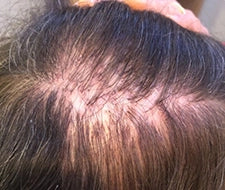
The scalp becomes visible
If there is an iron deficiency, this can lead to a restricted supply of oxygen and nutrients to the hair roots. As a result, the growth phase of the hair can shorten, causing more hairs to enter the resting phase earlier and eventually fall out. This is often perceived as diffuse hair loss, in which overall hair density decreases without necessarily creating individual bald spots.
Many of our customers support their hair during this phase with our hair care set for severe hair loss to care for the scalp holistically and create an optimal foundation for higher hair density.


Causes of hair loss after childbirth
The main cause of hair loss after pregnancy is the hormonal changes in the body. During pregnancy, estrogen levels rise significantly, and many expectant mothers often notice fuller and stronger-looking hair as a result. After birth, however, estrogen levels drop sharply again and the natural hormone cycle adjusts.
This hormonal adjustment during the postpartum period can cause more hairs to simultaneously enter the resting phase and subsequently fall out more noticeably. The altered cycle of the hair follicles is a normal biological process that affects many women after childbirth.
Other factors influencing hair loss after pregnancy
In addition to changes in estrogen levels, there are numerous factors that can also influence hair loss in women and hair growth after pregnancy. These include:
- Stress and lack of sleep: These can significantly promote hair loss after pregnancy. Stress alone can also be a reason for hair loss.
- General health: Taking medication or certain conditions, such as thyroid disorders, can also promote hair loss.
- Nutrient deficiency: Iron deficiency in particular is common in women and can have a negative effect on hair growth.
As a rule, hormone levels during pregnancy normalize on their own. However, if hair loss persists for an unusually long time or if you have the impression that another cause or condition is behind it, it may be advisable to see a doctor to receive appropriate treatment.

When hair grows back after childbirth
For most women, hair growth after pregnancy has regulated itself again within six to twelve months after birth. However, the actual duration of hair loss can vary individually. The key factor is when the hormones stabilize again and the natural hair cycle returns to balance.
As soon as the hormonal changes gradually normalize, excessive hair loss usually decreases as well. New hair grows back and the previously lost fullness can return step by step.
Erfahrungsbericht
Pflegeverlauf
Hair loss during breastfeeding?
Women who breastfeed often experience that the hormonal adjustment after pregnancy takes somewhat longer. This can also extend the period during which increased hair loss occurs. However, this does not automatically mean that the hair loss remains permanent. Even during breastfeeding, it is in most cases a temporary process. Are you observing hair loss in your baby? Learn from us what causes are behind it and what you can do about it.
What can help with hair loss after childbirth
If hair loss occurs as a result of iron deficiency or anemia, the underlying cause should first be medically clarified and treated accordingly. Beyond that, however, there are various natural measures that can meaningfully support the body and hair growth during this phase.
How our hair care products can support you
During and after postpartum hair loss, hair care tailored to individual needs can be beneficial. Our natural hair care products have been developed to gently care for hair and scalp and to complement the daily routine.
For daily use, we recommend our Hair Tonic, which cares for the scalp and can make hair appear fuller and more vital with regular use. Even during washing, mild care products can help to gently cleanse hair and scalp without unnecessarily stressing them.
For initial hair loss, our Hair Care Set for Long Hair with Beginning Hair Loss is also suitable. The coordinated products support a holistic care routine and can help to optimally support the hair during this phase.
Since the needs of hair and scalp vary individually, we additionally recommend a professional scalp analysis. This allows for a better assessment of personal needs and targeted selection of the right combination of care products.


Frequently asked questions about hair loss after childbirth
You can find answers to the most common questions about hair loss and pregnancy here in our brief FAQ:
For many women, hair loss begins about two to four months after birth. The reason is usually the adjustment of the hormone balance and estrogen production after the drop in estrogen levels.
In most cases, hair growth normalizes again within six to twelve months after childbirth. However, the exact duration can vary individually.
Yes, increased hair loss can also occur during breastfeeding. Since the hormonal adjustment in breastfeeding women often lasts longer, the period of hair loss can also be extended.
